Malorie opens her eyes at the river confluence
Bird BoxAt the river’s branching channels, Malorie opens her eyes for the first time in years, not because the danger has disappeared but because a recorded voice and the children’s hearing tell her that the creature has gone. The sight is kaleidoscopic, overwhelming, and beautiful; she shuts her eyes again and keeps rowing. The moment turns a survival rule into a chosen risk, and makes the river crossing a passage through memory as well as landscape.
Background and Approach
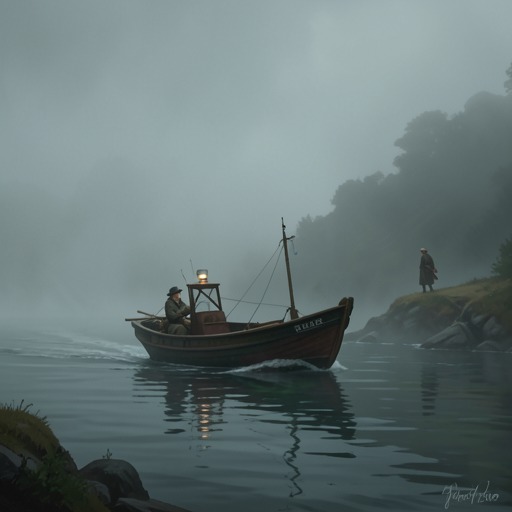
For years, Malorie has navigated a world where looking outside can mean madness or death. On the river she has trained the children to listen for what sight cannot safely reveal. Their boat strikes the banks, and each pause feeds her fear that unseen hands may reach for the blindfolds covering the children’s eyes. Yet the Boy helps free the boat, and the morning brings audible signs of a living landscape: birds singing, animals moving in the woods, and fish splashing in the water. Progress is real, but it comes through sound alone.
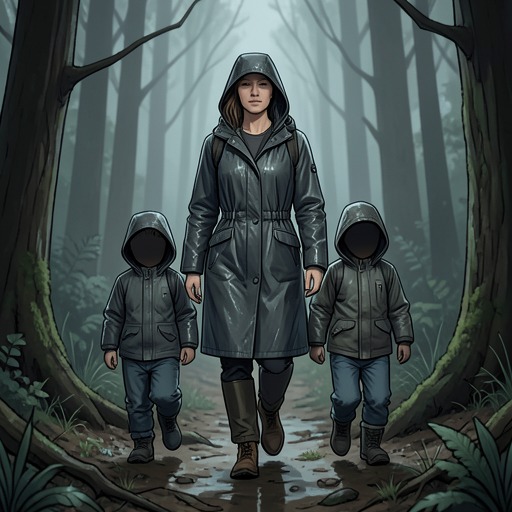
The children have been taught to interpret that sound since infancy. Malorie once carried them blindfolded to the forest’s edge and described leaves crinkling, or a small animal such as a rabbit, while remaining alert to the possibility of something more dangerous. She learned alongside them, but knew that she could not hear as well as they could: she had been raised to rely on sight and only learned as an adult to distinguish a raindrop from a tap on a window by sound. The river makes this difference matter. It is both an acoustic space in which the family must listen and a grave in which misjudgment can be fatal.
That dependence on hearing carries into the crossing’s final decision. Rick has explained that a motion-activated speaker near the route will play a forty-second recording on a thirty-minute loop; its sound marks the time to open her eyes. Malorie has resisted the instruction, telling Rick that she cannot do it. Four years pass before she reaches the channels he described. By then, the recording is not simply information: it is an imperfect guide through a place where she must judge when the protection of blindness has become an obstacle to finding the way forward.
The Creature and the Children’s Warning
When the boat reaches the decisive stretch, the current pulls it onward, and Malorie recognizes the sound of the water ahead as the approaching split. Rick’s recorded voice is playing nearby, but the creature is also near. Earlier, the Boy had heard someone rowing in time with Malorie, a phantom echo that raised the possibility of a pursuer. At the channels, the threat is immediate enough to make the children’s report essential: Malorie asks the Boy whether he hears anything else, and he eventually tells her that they are alone again and that the creature has gone away.
The exchange reverses the usual direction of care without undoing Malorie’s authority as their mother. She has trained the children to listen, and now their hearing supplies the knowledge she cannot obtain while blindfolded. She trusts them because she must. The boy’s answer does not make the world safe; it gives her a narrow interval in which to act. The river keeps moving, the speaker continues to sound, and the choice cannot be deferred indefinitely.
The recording also carries an older argument into the present. Tom once wondered whether the creatures meant to harm people, or whether the damage they caused was accidental, an overlap between their world and humanity’s. His voice now accompanies Malorie at the instant she must face what she has spent years avoiding. The recorded message does not resolve the creatures’ intentions. Instead, it gives Tom’s remembered uncertainty a place beside the practical danger: whatever the creatures mean, one is close, and Malorie has to decide whether to look.
The Moment of Sight
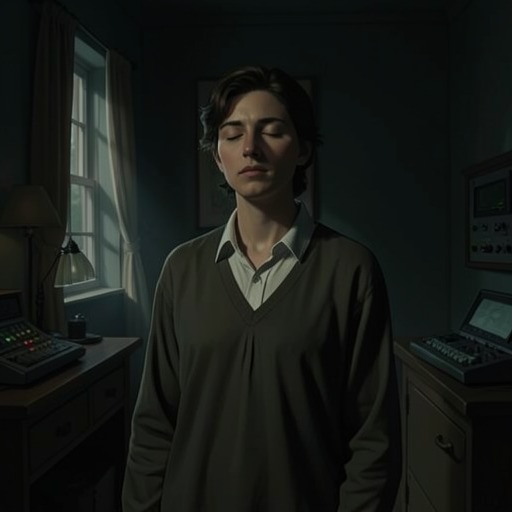
Tom’s voice grows so immediate that it seems to Malorie as if he is in the boat with her. She faces the channels and opens her eyes. At first she squints, not at the sunlight but at the colors. The sight empties her of words and ordinary thoughts; the world appears kaleidoscopic, endless, and magnificent. Its beauty is also physically difficult to bear. In the old world, she could have looked at a brighter scene without squinting; after years of darkness, even wonder hurts.
For a few seconds, the view tempts her to remain with it. Tom’s recorded voice urges her on, and she understands that she cannot keep the colors she sees. She closes her eyes and returns to the darkness she knows, then begins rowing again. The action makes the opening of her eyes neither a permanent escape from blindfolded life nor a defeat of the survival rule. It is a bounded exposure, taken for a purpose and ended before fascination can keep her from acting.
The sequence turns on a striking contrast: sight arrives as beauty, not as a narrated revelation of the creature. The creature’s precise appearance remains undescribed in this moment; what the text foregrounds is Malorie’s response to the colors and her decision to close her eyes. The danger is not erased by the magnificence of the world, and the beauty does not cancel the discipline needed to survive it. She looks, then willingly returns to darkness.
Memory, Change, and the Crossing
As Malorie rows toward the channel, the narration gathers earlier selves into the present journey. She rows with the person who learned she was pregnant, who found Shannon dead, who answered the newspaper advertisement, and who arrived at the house and agreed to let Olympia in. She remembers Gary’s arrival and the night Don pulled the blankets from the windows downstairs. These are not detached episodes: the memories accumulate as the history that has brought her, blindfolded, to this choice.
The crossing also makes visible the difference between Malorie at the beginning of the danger and Malorie now. By herself, she has raised two children in a world that grew more dangerous each day. The boat rocks against a bank as it enters the channel, turning the passage into something physical and unmistakable. Rick had estimated that the trigger lay only a hundred yards away; the current is moving fast, and the opening of her eyes has taken place within a rapidly closing interval. Memory does not stop the boat or remove the risk. It gives shape to the person who continues rowing.
Tom’s place in this reckoning is more than the sound of his voice. Malorie remembers his many acts and ideas, and the hope they gave her: that madness could be faced with a plan rather than by remaining still until it took a person apart. The recorded voice therefore joins an earlier practical influence to the present decision. Malorie’s change is not that she becomes fearless or abandons caution. She acts while afraid, trusts the children’s report, looks only briefly, and resumes the journey with the experience of what she has survived.
Narrative Significance
The scene brings the novel’s central survival problem into a single choice. Blindness has protected Malorie and the children, while sound has helped them interpret a world they cannot safely see. At the channels, neither system is sufficient on its own: a recording identifies the moment, the children report whether the creature is present, and Malorie must decide to look. Safety emerges from their different forms of knowledge working together, though the decision remains hers.
The river is both route and threat: its current carries the boat toward a passage, but its banks can halt it and its sounds must be read under pressure. The crossing’s form reflects that uncertainty. It moves between remembered disasters and immediate action, between Tom’s recorded voice and the children’s live hearing, and between the vivid colors of sight and the darkness Malorie deliberately chooses again. Her brief look changes neither the world’s danger nor the family’s need to keep going. Its significance lies in the passage from waiting for guidance to acting on it.